
Understanding military-related terminology can be confusing—especially when legal definitions, workplace rights, and federal protections are involved. One phrase you’ll often see on job applications, HR forms, or corporate compliance documents is 🚀protected veteran meaning🚀. If you’ve ever paused and wondered, “Wait… what does that even mean?” — you’re in the right place.
In this guide, we break it all down in a clean, simple, relatable way—no confusing legal jargon, no boring government talk—just real, helpful explanations that make sense.
⭐ Quick Answer (Read This First)
A protected veteran is someone who served in the U.S. military and qualifies for special employment protections under federal law (mainly via the Vietnam Era Veterans’ Readjustment Assistance Act). These protections are designed to prevent workplace discrimination and ensure equal opportunities in hiring, promotions, and benefits.
Now let’s go deeper—because there’s a lot more to know.
What Is a “Protected Veteran”? (In the Realest, Most Human Words Ever)

A “protected veteran” isn’t just any veteran.
It refers to specific categories of U.S. military veterans who are legally shielded from discrimination by employers—especially federal contractors and big companies with government ties.
These groups get extra support because they may have faced challenges such as service-connected disabilities, deployments interrupting their civilian life, or barriers returning to the workforce.
And yes—companies must follow federal guidelines to support these individuals fairly.
Why Protected Veterans Exist: The Purpose Behind the Law
Before this classification existed, many military members struggled with:
- Difficulty finding jobs after returning home
- Bias or discomfort from employers unfamiliar with military backgrounds
- Challenges caused by injuries or service-related disabilities
- Lack of support for transitioning back to civilian work
Federal laws were created to make sure military service doesn’t become a disadvantage when seeking employment.
So in simple terms:
👉 Protected veteran status = extra employment rights + legal safeguards + fair opportunities
The Four Main Types of Protected Veterans
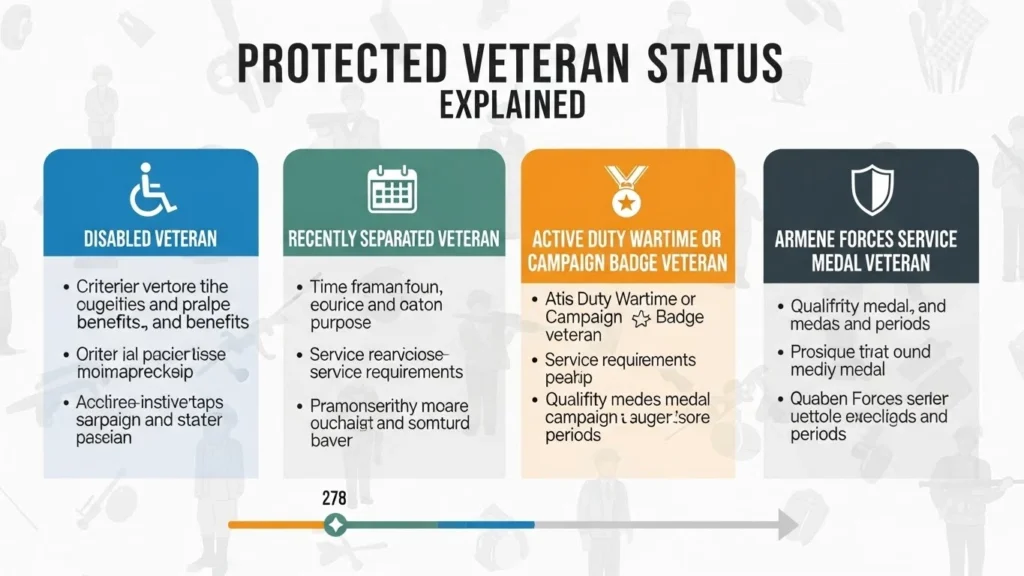
Not all service members fall under this status. Protected veterans belong to specific legally defined categories. Here’s the breakdown:
1. Disabled Veteran
A service member with a disability rating from the Department of Veterans Affairs (VA).
This includes:
- Physical injuries
- Mental health conditions
- Service-connected disabilities
Example:
A Marine who developed hearing loss due to combat zones may qualify.
2. Recently Separated Veteran
Anyone discharged or released from active duty within the past 3 years.
This category helps people transitioning into civilian work after military life.
Example:
Someone who ended active service in 2023 is protected until 2026.
3. Active Duty Wartime or Campaign Badge Veteran
Veterans who served during a war, campaign, or expedition where a campaign badge was awarded.
Example:
A soldier deployed to Afghanistan who earned a campaign badge is in this category.
4. Armed Forces Service Medal Veteran
Service members who participated in a U.S. military operation and earned an Armed Forces Service Medal.
Example:
Navy personnel deployed for humanitarian operations may qualify if they received this medal.
What Rights Do Protected Veterans Have?
These protections apply mainly in the workplace—especially for employers working with the federal government.
Here’s what they guarantee:
✔ No discrimination during hiring
Companies can’t reject applicants because of their military status.
✔ Fair treatment in promotions and raises
Service history cannot harm career growth.
✔ Reasonable accommodations
Particularly for disabled veterans.
✔ Priority for job openings
Some federal roles prioritize protected veterans.
✔ Protection from retaliation
You cannot be punished for identifying as a protected veteran.
✔ Federal reporting obligations for companies
Organizations must track and support veteran employment.
In short: the law makes sure veterans aren’t at a disadvantage in civilian work.
So… Why Do Job Applications Ask If You Are a Protected Veteran?
You’ve probably seen the question:
“Do you identify as a protected veteran?”
Here’s why companies ask:
- They must comply with federal laws
- Employers need to show they support equal opportunity hiring
- Reporting helps track veteran employment progress
- Companies want to avoid unintentional discrimination
- Veteran status may qualify them for specific diversity programs
Important Note:
Your answer is voluntary. You cannot be penalized for choosing not to disclose. Your information is confidential and used only for compliance—not hiring decisions.
Does Being a Veteran Automatically Make You a Protected Veteran?
Nope. That’s a common misconception.
You’re only a protected veteran if you fall into one of the four categories listed earlier.
Here’s a quick checklist:
| Veteran Type | Protected? |
|---|---|
| Served in military but without special category | ❌ Not automatically |
| Disabled veteran | ✔ Yes |
| Recently separated | ✔ Yes |
| Campaign badge awardee | ✔ Yes |
| Service medal recipient | ✔ Yes |
Examples of Who Is and Is Not a Protected Veteran
Is Protected:
- A veteran discharged within the last 3 years
- A soldier with a service-connected knee injury
- A Marine awarded a campaign badge for deployment
- A Navy member who earned an Armed Forces Service Medal
Is Not Protected:
- Someone who served 10 years ago and doesn’t fall into any category
- A National Guard member with no qualifying medals or deployments
- A veteran with no service-related disability and no campaign involvement
Common Misunderstandings (Cleared Up the Easy Way)
❌ Myth 1: “If I select ‘protected veteran’ on an application, I’ll get special treatment.”
Truth:
It’s for compliance, not preference.
❌ Myth 2: “I have to tell employers about my veteran status.”
Truth:
Disclosure is entirely optional.
❌ Myth 3: “Companies can’t ask about veteran status.”
Truth:
They can—but they can’t use it to discriminate.
❌ Myth 4: “Protected veterans can’t be fired.”
Truth:
They can—just not because they’re protected veterans.
Why This Matters for Gen-Z Veterans Entering the Workforce
Gen-Z includes a growing number of military service members transitioning into civilian roles.
Knowing this status matters because:
- You can access career support programs
- You’re shielded from certain biases
- You may qualify for VA benefits
- Employers may offer veteran-specific opportunities
- It helps you understand your legal rights
Transitioning from military to civilian work is hard enough. This protection makes the journey smoother.
How Employers Support Protected Veterans (What Good Companies Actually Do)
Many organizations now go above and beyond legal requirements.
They may offer:
🌟 Veteran hiring initiatives
Priority recruitment, outreach events, and dedicated HR teams.
🌟 Mentorship programs
Pairing veterans with fellow former service members.
🌟 Skills translation help
Converting military experience into civilian job qualifications.
🌟 Training for HR staff
Ensuring fair treatment and awareness of veteran issues.
🌟 Mental health & well-being resources
Especially for those adjusting after deployments.
Real-Life Scenarios to Understand Protected Veteran Status
Scenario 1: Recently Separated Veteran
Jordan left active duty 18 months ago.
He applies to a major tech company.
When asked about protected veteran status, he marks “yes.”
This gives him:
- Protection from discrimination
- Access to veteran-specific hiring programs
Scenario 2: Disabled Veteran
Ava has a VA-rated disability from her service.
Her employer must provide reasonable accommodations—like ergonomic tools or flexible schedules.
Scenario 3: Campaign Badge Veteran
Dylan was deployed and earned a campaign badge.
A federal contractor cannot deny him employment because of his deployment history.
These examples show how the law protects real people in real situations.
Protected Veteran Status vs. Veteran Status: Quick Comparison
| Feature | Protected Veteran | General Veteran |
|---|---|---|
| Legally shielded from discrimination | ✔ | Depends |
| Covered under VEVRAA | ✔ | ❌ |
| Gets employer reporting protection | ✔ | ❌ |
| Must fall into specific categories | ✔ | ❌ |
| Includes all former military members | ❌ | ✔ |
How to Know If You Qualify
Ask yourself:
- Do I have a VA disability rating?
- Did I leave active duty within the last 3 years?
- Did I earn a campaign badge?
- Did I receive an Armed Forces Service Medal?
If yes to any → you’re a protected veteran.
If no to all → you are a veteran, just not in the protected category.
Final Thoughts: Why This Definition Actually Matters
Protected veteran status isn’t just a legal term—it’s a support system.
It exists to make sure the people who served the nation receive fairness, respect, and equal opportunities in civilian life.
Whether you’re a veteran checking your status, an HR manager seeking clarity, or just someone curious after seeing that checkbox on a job form—understanding this concept empowers you.
It ensures:
- Veterans are treated with fairness
- Employers follow federal law
- Everyone has clarity and confidence
And most importantly—military service becomes a strength, not a barrier.
